COFFEE & A ROLL
This website contains content related to cannabis.
Are you 21 years of age or older?
By entering, you confirm you meet the legal age requirement
in your jurisdiction for cannabis-related content.
Region
Ancient Civilizations
Established
~2700 BC
Cultivation
Ancient — Wild & Cultivated
Legal Status
Ancient Empire — Sacred Medicine
History
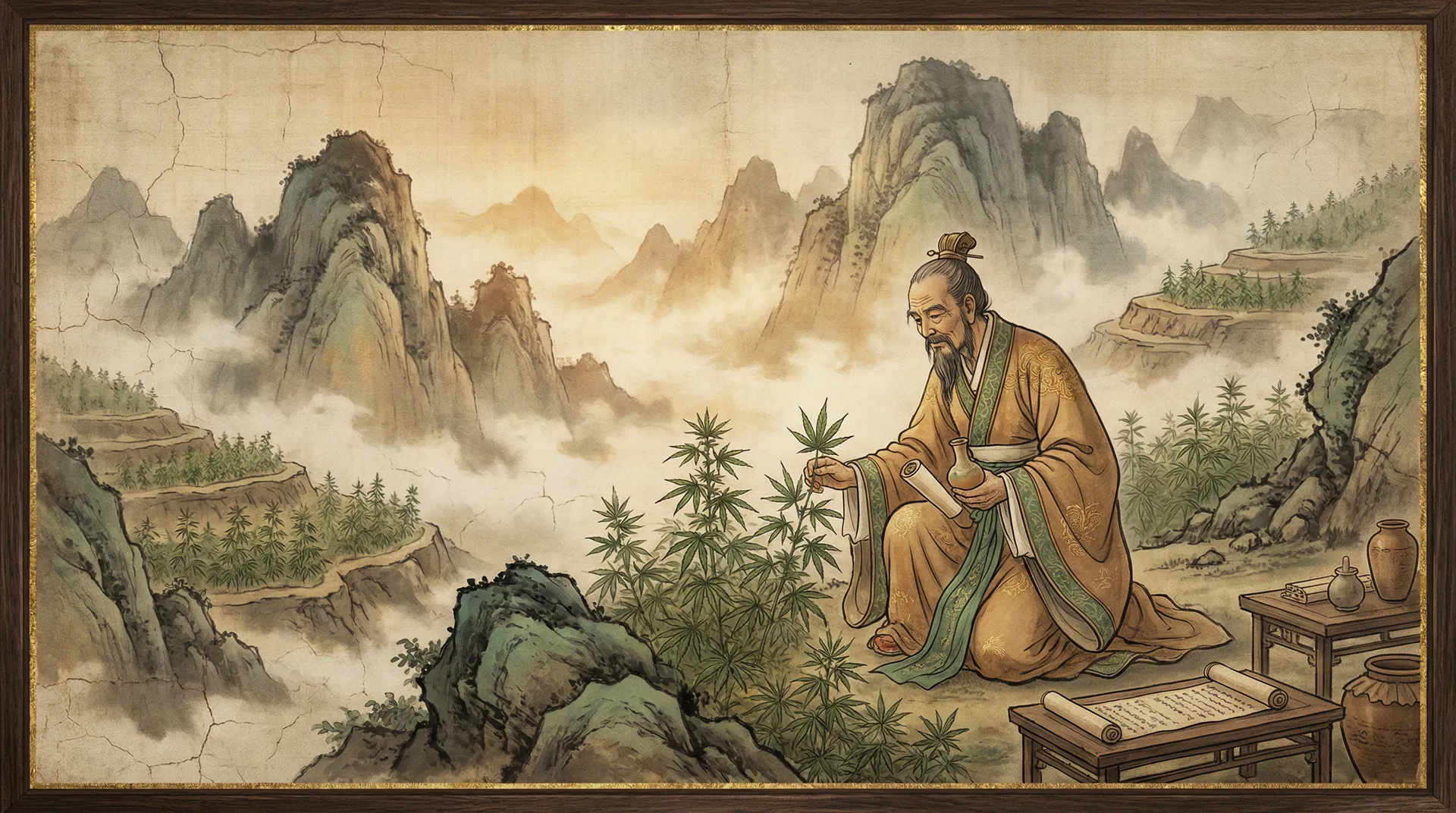
The story of cannabis as medicine begins in ancient China, with the legendary Emperor Shen Nung — the 'Divine Farmer' — who is credited with discovering the medicinal properties of cannabis around 2700 BC. His compendium, the Pen Ts'ao (BenCao Jing), catalogued 365 medicinal herbs, with cannabis listed as one of the 'Supreme Elixirs of Immortality.'
The Chinese character Má (麻) means hemp and cannabis, and it appears embedded in words for 'numbness' and 'anesthesia' — a linguistic fossil revealing how deeply cannabis was woven into Chinese healing. The legendary surgeon Hua Tuo of the Han dynasty (2nd century AD) is said to have performed surgery under cannabis-based anesthesia, a preparation called mafeisan.
In 2019, archaeologists made a stunning discovery at the Jirzankal cemetery in China's Pamir Mountains: 2,500-year-old wooden braziers containing cannabis residue with elevated THC levels. This proved that ancient peoples in western China were deliberately cultivating high-potency cannabis for psychoactive use — the oldest direct evidence of cannabis smoking in the world.
Even earlier, a Tocharian shaman buried circa 750 BC was found with approximately 800 grams of cultivated, high-THC cannabis — a staggering quantity that speaks to the plant's central role in ancient spiritual practices along the Silk Road.
Cultivation
Cannabis was one of the earliest cultivated crops in China, grown for fiber (hemp), food (seeds), oil, and medicine. Archaeological evidence shows cannabis cultivation dating back at least 6,000 years in the Yellow River valley.
Ancient Chinese farmers developed sophisticated techniques for growing hemp, selecting plants for different purposes — tall, fibrous varieties for rope and textiles, and resinous flowering varieties for medicine and ritual.
The Pamir Mountain discoveries suggest that high-altitude cultivation was practiced to produce more potent, resinous plants — a technique that mirrors modern understanding of how UV stress at altitude increases cannabinoid production.
Hash Making & Processing
Ancient Chinese texts describe various preparations of cannabis — dried flowers burned as incense, seeds pressed for oil, and leaves steeped in teas and decoctions.
The Jirzankal braziers represent the oldest known method of cannabis concentrate consumption — hot stones placed in enclosed wooden vessels, with cannabis placed on top to vaporize the resin and trap the smoke.
Legal Landscape
In ancient China, cannabis was a revered medicine and sacred plant. There were no prohibitions — it was freely cultivated and used across social classes.
Modern China has some of the strictest drug laws in the world, with severe penalties for cannabis possession. The irony of the world's oldest cannabis culture having among its harshest modern prohibitions is not lost on historians.
Key Figures
Emperor Shen Nung — the 'Divine Farmer,' father of Chinese medicine
Hua Tuo — Han dynasty surgeon who used cannabis anesthesia
The Tocharian shamans of the Pamir Mountains