COFFEE & A ROLL
This website contains content related to cannabis.
Are you 21 years of age or older?
By entering, you confirm you meet the legal age requirement
in your jurisdiction for cannabis-related content.
Region
Ancient Civilizations
Established
~500 BC (Herodotus)
Cultivation
Wild & Nomadic Cultivation
Legal Status
Ancient — Ritual & Funerary
History
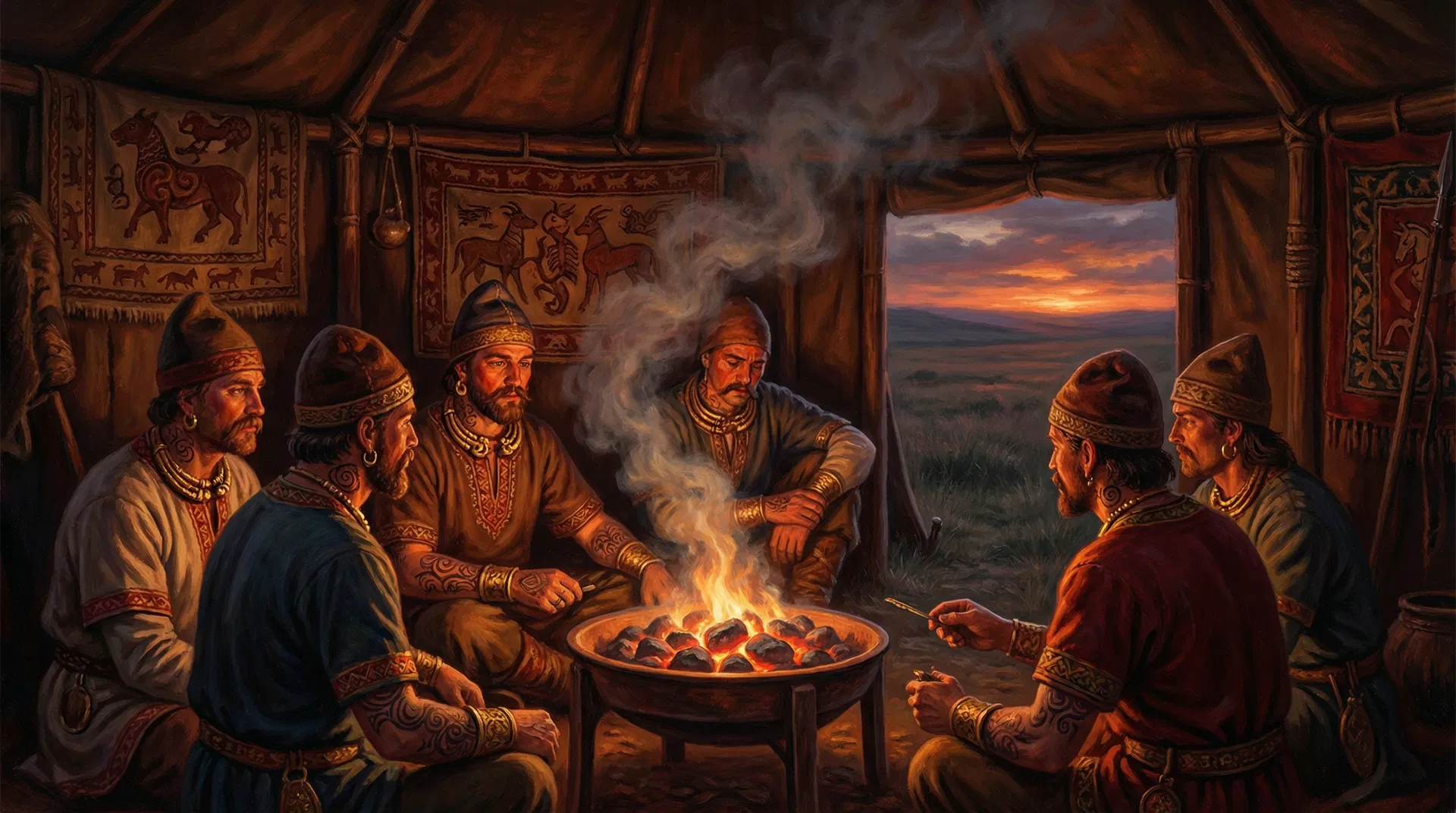
The Scythians were fierce nomadic warriors who roamed the vast Central Asian steppes from approximately 900 BC to 200 BC. They are among the most important figures in cannabis history — the people who spread the plant and its ritual use across the entire Eurasian continent.
Herodotus described their funeral customs in detail: after burying their dead, the Scythians would erect small tent structures of felt, place a dish of red-hot stones inside, and throw cannabis seeds upon them. 'The Scythians, as I said, take some of this hemp-seed, and, creeping under the felt coverings, throw it upon the red-hot stones; immediately it smokes, and gives out such a vapour as no Grecian vapour-bath can exceed; the Scyths, delighted, shout for joy.'
Archaeological confirmation came dramatically in 1947 with the excavation of the Pazyryk frozen tombs in Siberia's Altai Mountains. Inside 2,400-year-old burial chambers, archaeologists found perfectly preserved cannabis seeds, bronze censers, and felt tents — exactly matching Herodotus's description. The frozen conditions had preserved the evidence for millennia.
The Scythians' vast trade networks and nomadic migrations carried cannabis from its Central Asian homeland westward to Europe and southward to Persia and India, making them perhaps the single most important vector for the global spread of cannabis culture.
Cultivation
As nomads, the Scythians did not practice settled agriculture in the traditional sense. However, they gathered wild cannabis from the abundant stands that grew across the Central Asian steppes and likely cultivated small plots at seasonal camps.
The Pazyryk tombs contained cannabis with elevated THC levels, suggesting the Scythians were selecting for psychoactive potency — an early form of selective breeding.
Hash Making & Processing
The Scythian method — vaporizing cannabis on hot stones in enclosed felt tents — was an ingenious early concentrate consumption technique. The enclosed space trapped the cannabinoid-rich vapor, creating an intensely psychoactive experience.
This technique is essentially a primitive vaporizer, and the principle is identical to modern dab rigs and vaporizers — applying heat to cannabis to release its active compounds without combustion.
Legal Landscape
The Scythians had no written legal code. Cannabis was a central part of their culture — used in funerals, religious rituals, and likely daily life.
Their legacy lives on in the genetics of every cannabis plant that traces its lineage to Central Asian origins.
Key Figures
Herodotus — who preserved the Scythian cannabis tradition for posterity
The Pazyryk chieftains whose frozen tombs confirmed the historical record
Sergei Rudenko — archaeologist who excavated the Pazyryk tombs in 1947